
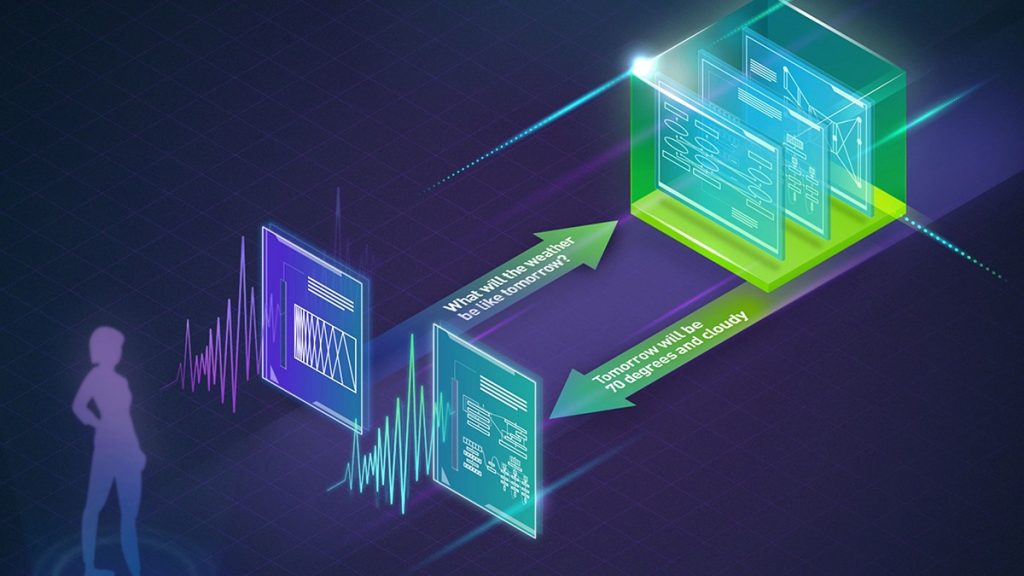

Nvidia, a company synonymous with powerful GPUs, has strategically expanded its reach into cloud computing, not as a general-purpose cloud provider like AWS or Google Cloud, but as a specialist in accelerating demanding workloads, particularly in AI, high-performance computing (HPC), and industrial metaverse applications. Their cloud offerings are designed to maximize the performance of their GPU hardware and the software ecosystem built around it.
Here’s an overview of Nvidia’s key cloud computing services and their diverse applications:
1. NVIDIA DGX Cloud
NVIDIA DGX Cloud is a fully managed AI supercomputing service that provides enterprises with on-demand access to NVIDIA’s most powerful AI infrastructure. It’s offered in collaboration with leading cloud providers like Oracle Cloud Infrastructure (OCI), Microsoft Azure, and Google Cloud.
Key Features:
Dedicated DGX Infrastructure: Provides direct access to NVIDIA’s DGX systems (e.g., powered by NVIDIA H100 or A100 Tensor Core GPUs), designed specifically for large-scale AI training and development.
NVIDIA AI Enterprise Software Stack: Comes pre-integrated with the full NVIDIA AI Enterprise software suite, including AI frameworks, libraries, tools, and pre-trained models optimized for GPU performance. This simplifies the setup and ensures optimal performance.
Managed Service: NVIDIA manages the underlying infrastructure, allowing users to focus entirely on their AI development and deployment.
Scalability: Designed for multi-node training, enabling the scaling of AI workloads across numerous GPUs for faster training times.
Expert Support: Often includes access to NVIDIA’s AI experts and dedicated technical account managers.
Applications:
Large Language Model (LLM) Training and Fine-tuning: Crucial for developing and customizing generative AI models for various industries, such as:
Customer Service: Building advanced chatbots and virtual assistants.
Content Generation: Creating high-quality text, code, images, and videos.
Drug Discovery: Accelerating the development of new therapeutics and biomolecular models.
Generative AI Development: Powering the creation of new AI applications that generate novel content.
Complex AI Model Training: Accelerating the training of deep learning models for various tasks, including:
Computer Vision: Image recognition, object detection, video analytics.
Speech AI: Natural Language Processing (NLP), speech recognition, translation.
Enterprise-Grade AI: Providing a secure, stable, and high-performance environment for mission-critical AI applications in enterprises.
AI Research and Development: Enabling researchers and data scientists to experiment with large models and complex AI architectures.
2. NVIDIA Omniverse Cloud
NVIDIA Omniverse Cloud is a platform-as-a-service (PaaS) designed for developing and deploying industrial metaverse applications. It enables real-time 3D design collaboration, physically accurate simulation, and the creation of digital twins in the cloud.
Key Features:
Universal Scene Description (OpenUSD) Integration: Built on OpenUSD, a framework for describing, composing, and simulating 3D worlds, enabling interoperability across different 3D applications.
Real-time Ray Tracing and Path Tracing (RTX): Leverages NVIDIA RTX technology for high-fidelity, physically accurate rendering and simulation.
Cloud-Native Environment: Provides the infrastructure and tools for streaming and collaborating on complex 3D workflows directly from the cloud.
Scalability: Supports large-scale, complex 3D environments and multiple users collaborating in real time.
Applications:
Digital Twin Development: Creating highly accurate and interactive virtual replicas of physical assets, factories, cities, or products for:
Manufacturing: Simulating production lines, optimizing factory layouts, virtual prototyping.
Architecture, Engineering, and Construction (AEC): Collaborative design reviews, urban planning, building lifecycle management.
Logistics: Simulating warehouse operations and supply chains.
Industrial Metaverse: Building immersive, collaborative 3D environments for various industrial applications.
Computer-Aided Engineering (CAE) Workflows: Accelerating simulations and analyses in real-time, for fields like fluid dynamics, structural analysis, and more.
Synthetic Data Generation (SDG): Creating high-quality, diverse synthetic datasets for training AI models, especially in robotics and autonomous systems, reducing the need for expensive and time-consuming real-world data collection.
Robotics Simulation: Virtually training, testing, and validating robotic systems in physically accurate environments before deployment.
Autonomous Vehicle Development: Simulating driving scenarios and training AI models for self-driving cars.
Scientific Visualization: Enabling researchers to visualize large datasets at interactive speeds, accelerating scientific discovery.
Extended Reality (XR) Experiences: Developing immersive design reviews and interactive virtual environments for training, education, and collaboration.
3. NVIDIA NGC (NVIDIA GPU Cloud)
NVIDIA NGC is not a cloud service in itself, but a crucial hub for GPU-optimized software, serving as a repository of containers, pre-trained models, industry-specific SDKs, and Helm charts. It facilitates the deployment of NVIDIA’s accelerated computing software on various cloud platforms and on-premises infrastructure.
Key Offerings:
Containerized Software: Provides ready-to-use Docker containers for popular AI frameworks (TensorFlow, PyTorch), HPC applications, and data science tools, ensuring consistent and optimized performance.
Pre-trained Models: Offers a catalog of pre-trained AI models that can be fine-tuned for specific tasks, reducing development time.
Industry-Specific SDKs: Provides software development kits (SDKs) tailored for domains like healthcare (NVIDIA Clara), conversational AI (NVIDIA Riva), and robotics (NVIDIA Isaac).
Applications (via deployment on cloud platforms):
AI Development and Deployment: Streamlining the entire AI lifecycle, from data preparation and model training to inference, across any cloud environment.
High-Performance Computing (HPC): Running complex scientific and engineering simulations with optimized performance.
Data Science and Analytics: Accelerating data processing, machine learning, and deep learning workflows.
Cloud-Native AI: Facilitating the deployment of GPU-accelerated workloads on Kubernetes in public clouds.
4. NVIDIA AI Enterprise
NVIDIA AI Enterprise is a comprehensive, cloud-native suite of AI and data analytics software, optimized and supported by NVIDIA. While it can run on-premises, it’s also designed for seamless deployment and management within cloud environments (e.g., on VMware vSphere within a private cloud, or in public cloud instances).
Key Components:
AI Frameworks and Libraries: Optimized versions of popular AI frameworks and accelerated libraries (e.g., CUDA-X, cuDNN).
NVIDIA Operators: Kubernetes operators (GPU Operator, Network Operator, NIM Operator) to automate the deployment and management of GPU-accelerated applications.
Management Tools: Tools like NVIDIA Base Command for managing AI development and deployment.
NVIDIA NIM Microservices: Easy-to-use microservices for deploying and scaling generative AI models with high performance.
Applications (in cloud environments):
Production AI Workloads: Providing the necessary software foundation for deploying and scaling mission-critical AI applications in the cloud, including generative AI, computer vision, and speech AI.
Hybrid Cloud AI: Enabling organizations to build and deploy AI solutions that can seamlessly run across public clouds, private clouds, and edge environments.
AI Infrastructure Management: Simplifying the orchestration and management of GPU resources for AI workloads in cloud-native environments.
Domain-Specific AI: Powering AI solutions across various industries by leveraging specialized SDKs within the suite (e.g., NVIDIA Clara for healthcare, NVIDIA Metropolis for smart cities).
In essence, Nvidia’s cloud computing strategy is about democratizing access to its leading-edge GPU technology and integrated software stack for specific, high-value workloads. Instead of being a generalized cloud provider, Nvidia acts as a powerful enabler, supercharging AI, simulation, and 3D collaboration capabilities within and across existing cloud ecosystems.


