
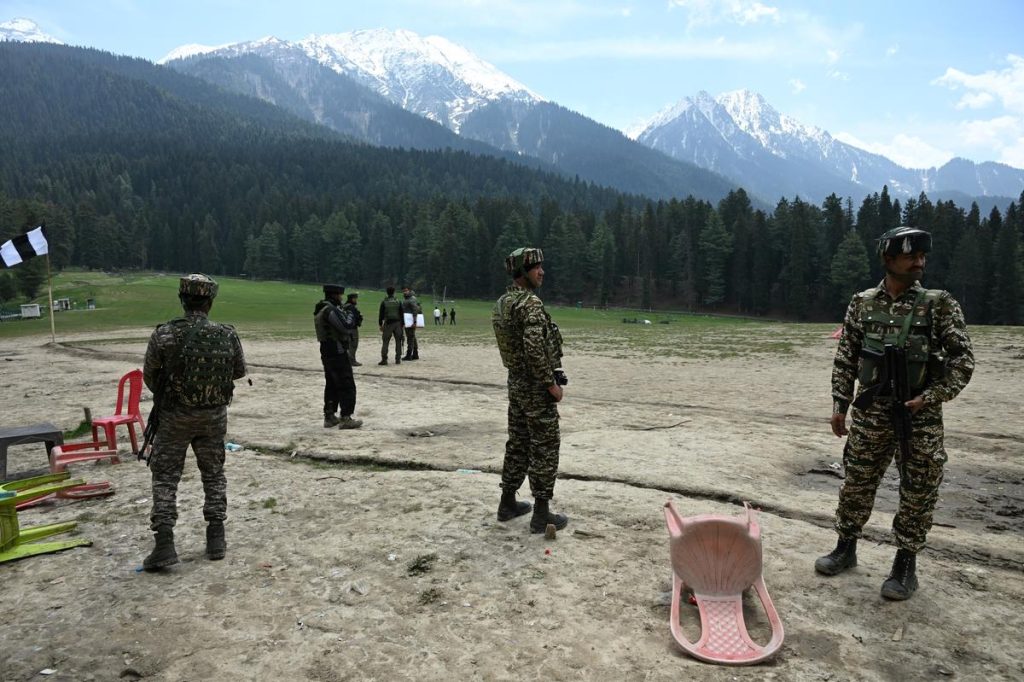

The April 22, 2025, terrorist attack in Pahalgam was a complex event with multiple layers of responsibility and denial. While the attack was initially claimed by one group, Indian authorities and international observers have pointed to its connections to a larger, more established terrorist organization.
The Resistance Front (TRF)
Initial Claim and Subsequent Denial: The Resistance Front (TRF) initially claimed responsibility for the Pahalgam attack via social media. In its statement, the group justified the attack by claiming it was in response to India’s policy of allowing non-locals to settle in Jammu and Kashmir, a policy they believe is aimed at demographic change. However, as international and domestic condemnation mounted, the group later retracted its claim, alleging that the initial post was a result of a “coordinated cyber intrusion” by Indian intelligence.
Background: The TRF is an Islamist militant organization that emerged in 2019, shortly after the Indian government’s abrogation of Article 370, which removed the special status of Jammu and Kashmir. The group attempts to project itself as an indigenous Kashmiri resistance movement with a more secular image, notably by using a non-religious name and symbolism.
Status: Despite its attempts to appear as an independent entity, the TRF is widely considered to be a front or proxy for the Pakistan-based Lashkar-e-Taiba (LeT). It has been actively involved in recruiting and has claimed responsibility for several attacks targeting Indian security forces and civilians. The U.S. designated the TRF as a “Foreign Terrorist Organization” and a “Specially Designated Global Terrorist” on July 17, 2025, explicitly noting its ties to Lashkar-e-Taiba and its claim of responsibility for the Pahalgam attack.
Lashkar-e-Taiba (LeT)
Alleged Role: Both India and the United States have stated that the TRF is a proxy for Lashkar-e-Taiba (LeT). This connection is supported by the fact that LeT is also a proscribed terrorist group with a history of carrying out major attacks in India, including the 2008 Mumbai attacks. Indian authorities have provided evidence linking the three terrorists killed in a subsequent counter-terrorism operation—Suleman, Hamza Afghani, and Zibran—to LeT and the Pahalgam attack.
Background: LeT, whose name means “Army of the Pure,” is a Pakistan-based Islamist militant organization. It was founded in the late 1980s with the stated objective of integrating all of Kashmir with Pakistan and establishing an Islamic state across the Indian subcontinent. The group has been designated as a terrorist organization by the United Nations, the United States, and several other countries. It is widely believed to be supported by Pakistan’s Inter-Services Intelligence (ISI).
Other Groups and Wider Context
While the TRF and LeT were the primary groups linked to the Pahalgam attack, Indian authorities have also implicated other Pakistan-based groups likeJaish-e-Mohammed (JeM) andHizb-ul-Mujahideen (HuM) in the wider terrorism ecosystem in Kashmir. These groups are often accused of working in a coordinated manner, with the support of elements within the Pakistani state, to carry out attacks and destabilize the region.
The background of the groups involved in the Pahalgam attack reflects a broader pattern of “plausible deniability” where a more established, internationally-sanctioned group like LeT uses a newer, local-sounding proxy like TRF to conduct attacks, complicating the diplomatic response and international efforts to hold state sponsors of terrorism accountable.


