
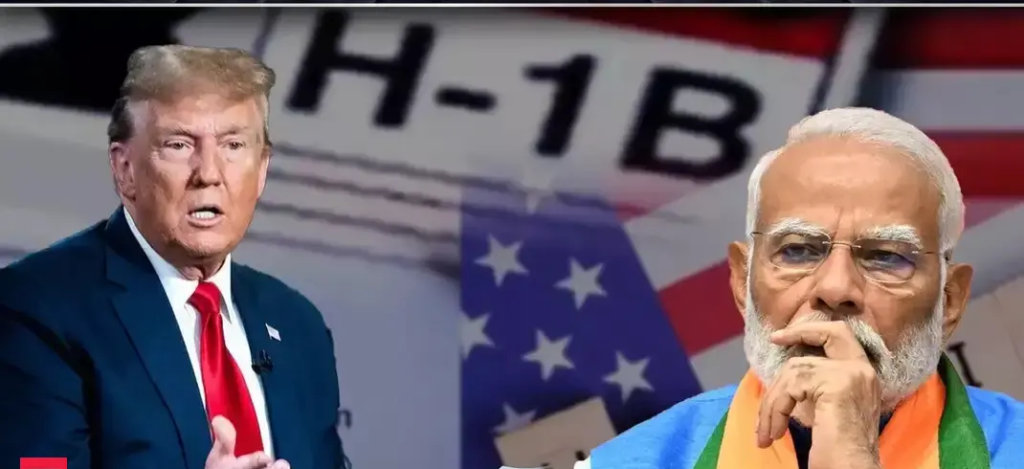

President Donald Trump’s H-1B visa proclamation is expected to have a significant and multifaceted impact on India, particularly its technology sector and its skilled professionals. Given that India accounts for over 70% of all H-1B visa approvals, the country is uniquely vulnerable to changes in the program.
Official and Industry Reactions
The Indian government has officially expressed“serious concern” over the move. In a statement, India’s Ministry of External Affairs said it is studying the full implications and hopes that the“humanitarian consequences” caused by disruptions to families can be addressed. The government has also set up an emergency assistance number for Indian nationals in the U.S. who may be affected.
The Indian IT industry body, NASSCOM, has also raised alarms. It criticized theone-day deadline for implementation, noting it creates“considerable uncertainty” for businesses and professionals. While some industry veterans believe the impact will be minimal due to a reduced reliance on H-1B visas in recent years, others have warned of potential disruptions to ongoing projects and business continuity for Indian technology services companies with operations in the U.S.
Potential Impacts on the Indian Economy and Workforce
The H-1B fee hike is expected to create several direct and indirect impacts on the Indian ecosystem:
Increased Offshoring: Many experts and industry leaders predict that the steep cost of hiring talent in the U.S. will accelerate the existing trend ofoffshoring. This could lead U.S. companies to move more projects and jobs to India, boosting the country’s Global Capability Center (GCC) industry and providing more high-value jobs at home.
“Reverse Brain Drain”: The prohibitive cost and uncertainty surrounding the H-1B program could encourage skilled Indian professionals toreturn to India or seek opportunities in other countries. This “reverse brain drain” could benefit India by bringing back talent with global experience, capital, and networks, which could in turn help grow the Indian startup ecosystem.
Shift in Talent Strategy: Indian IT firms may respond by further increasing local hiring in the U.S. and focusing more on L-1 visas for intra-company transfers, though this visa category is also under scrutiny. The companies’ overall dependency on H-1B visas for new talent is expected to decrease.
Economic Uncertainty: The proclamation adds to the existing economic headwinds faced by India’s IT sector, including delays in client decisions and global trade tensions. The potential for more restrictive policies, such as the proposedHalting International Relocation of Employment (HIRE) Act, which could impose a tax on offshore payments, further heightens this uncertainty.
Impact on Indian Professionals and Families
Financial Burden: The $100,000 fee, a significant jump from previous costs, makes sponsoring new H-1B visas prohibitively expensive for many employers, especially smaller firms. This directly impacts Indian professionals seeking to work in the U.S., as most employers will be unwilling or unable to bear such a cost unless the individual’s expertise is exceptionally critical. The fee alone can exceed the annual salaries of many professionals, making it economically unviable for broad hiring.
Uncertainty and Anxiety: Despite clarifications that the fee does not apply to existing visa holders or renewals, the initial confusion led to widespread anxiety. Many H-1B holders and their families reconsidered international travel, fearing re-entry issues. This continuous uncertainty can lead to stress and make it challenging for professionals to plan their long-term careers and family lives in the U.S.
Disruption to Education and Family Life: For those who cannot meet the new requirements or whose employers decide against sponsoring new visas, the proclamation can lead to job disruption, and consequently, challenges for families and children, including disruptions to education.
“Pay-to-Play” System: Critics from India and within the U.S. have labeled the new policy a “pay-to-play” system, effectively shutting out a significant portion of highly skilled professionals who do not have employers willing or able to pay the exorbitant fee.
Strategic Implications for India’s Tech Sector
While the immediate impact is seen as a blow, many Indian industry leaders and policymakers believe this could be acatalyst for a “reverse brain drain” and a strategic opportunity for India.
Acceleration of Offshoring and Nearshoring: With higher costs for onsite hires in the U.S., American companies, including major tech firms and Wall Street banks, are expected to accelerate theiroffshoring to India andnearshoring to countries like Canada and Mexico. This could boost India’s Global Capability Centers (GCCs), expanding job opportunities within India for skilled professionals.
Talent Retention and “Brain Gain”: The H-1B restrictions may compel more top-tier Indian engineers, scientists, and tech leaders to remain in India or return from abroad. This influx of talent, armed with global experience and networks, could significantly enhance India’s innovation potential, accelerate its startup ecosystem, and drive deeper tech fields like AI and robotics.
Strengthening Domestic Innovation: If leveraged wisely, this shift could allow India to transition from primarily being a “talent exporter” to becoming a “global innovation hub.” Policymakers are urged to create an enabling ecosystem with robust infrastructure, venture capital, and supportive policies to absorb and utilize this talent effectively. Union Education Minister Dharmendra Pradhan has emphasized India’s strong talent pool and the expansion of domestic institutions like IITs and central universities to meet these aspirations.
Bilateral Relations: The Indian government views talent mobility as a significant contributor to technology development, economic growth, and competitiveness in both countries. India is engaging in diplomatic dialogue with the Trump administration, emphasizing mutual benefits and strong people-to-people ties, hoping to address the disruptions.
Sentiment in India
The sentiment in India is a mix of concern, resolve, and a sense of opportunistic determination. While there is “panic” among some individuals directly affected, there’s also a strong belief that India’s growing economy and robust tech sector can absorb and benefit from this talent redirection. Figures like former Niti Aayog CEO Amitabh Kant have declared that “America’s loss will be India’s gain,” predicting that the policy will “choke US innovation and turbocharge India’s.”


